Thursday, April 24, 2014

Circuit Breaker and Fuse Market: Scope, Trends and Forecasts by 2018.

Why do we use Circuit Breakers?

  • We use Circuit Breakers to protect an electrical circuit or equipments from the damage caused by an overload of electricity or short circuit.
  • The basic function of Circuit Breaker is to interrupt the current flow whenever there is flow of electricity more than an peak value or level.

Difference between Fuse and Circuit Breaker

Fuse is used once and then if the fuse is damaged then there must be a replacement for the fuse.
Unlikely the circuit breaker can be used several times by just resetting it either by manually or automatically.

Depending on the Voltage level of installation, Types of Circuit Breakers are :
1) Low-voltage circuit breakers
These Circuit breakers are generally made for direct current (DC) applications. These are commonly used in domestic, commercial and industrial application for less than 1000 volts.

2) Medium-Voltage circuit breakers
These breakers can be assembled into metal enclosed switchgear line ups for indoor applications, or as individual components for outdoor applications like substations.
Examples: Vacuum circuit breakers, air circuit breakers and SF6 circuit breakers

3) Thermal magnetic circuit breakers
It is the common type of circuit breaker which is found in  most Distribution Boards.It Senses circuit current through the production of heat.
Thermal magnetic circuit breakers Generally uses some type of heating element in series with the load.

4) Magnetic circuit breakers
These circuit breakers uses solenoid(Electromagnet) which opposes to the current as the load of current increases beyond capacity. As the current in solenoid increases beyond the capacity of circuit breaker the solenoid resist to the flow of current by pulling a latch which lets the contacts open.

Operating Mechanism of Circuit Breaker

Circuit Breaker consist of two contacts
1) Fixed Contacts
2) Moving Contacts

Moving contact is used for the purpose of making  and breaking of the circuit by using stored energies in the form of spring or compressed air.
Spring, pneumatic or oil damping is used to arrest the speed of mc while closing.FC contains a spring which holds the mc after closing.

Internal parts of Circuit Breaker


Parts of Circuit breaker


Parts of Circuit breaker
1. Actuator lever :-
It is used to manually trip and reset the circuit breaker. It also indicates the status of the circuit breaker (On or Off/tripped). Most breakers are designed so they can still trip even if the lever is held or locked in the "on" position. This is sometimes referred to as "free trip" or "positive trip" operation.
2. Actuator mechanism - forces the contacts together or apart.
3. Contacts - Allow current when touching and break the current when moved apart.
4. Terminals
5. Bimetallic strip
6. Calibration screw - allows the manufacturer to precisely adjust the trip current of the device after assembly.
7. Solenoid
8. Arc divider/extinguisher
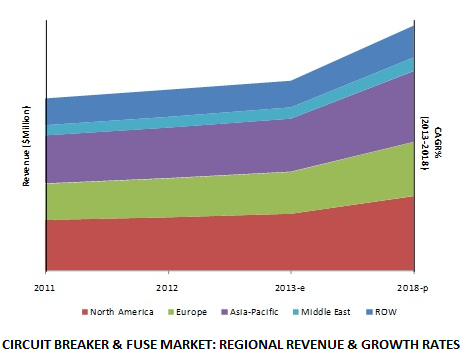
Circuit Breaker Market: Trends and Forecasts 

From the  revenue and growth rate given below, we can conclude that the America is the Dominating country for Circuit Breaker market. Followed by America the Asia Pacific is the second dominating country for the revenue of circuit breaker market.

http://www.prweb.com/releases/circuit-breaker-and-fuse/market/prweb11640709.htm 

The global market is worth $11,700 million in 2013 and is estimated to reach $15,100 million by 2018, growing at a CAGR of 5.2% from 2013 to 2018. 


For more Information regarding the Circuit Breaker Market: Click Here.


Tuesday, April 15, 2014

Industrial Enzymes applications and Scope of the Market with trends and forecasts of the market.

Enzyme

  • Enzymes are large biological molecules which are used as a catalyst in a biochemical reaction.
  • The function of a Enzyme as a catalyst is to speed up the reaction, by lowering the rate of activation energy(the minimum energy that must be input to a chemical system, containing potential reactants, in order for a chemical reaction to occur).
  • Enzymes which are the molecules of protein made up from Amino acid chains, are produced by all living organisms and by all plants.

Types of Enzymes according to the Reactions that they support
http://www.prweb.com/releases/industrial-enzymes-market/03/prweb11683321.htm


1) OXIDOREDUCTASES: These are the enzymes used to perform Oxidation and Reduction reactions
2) TRANSFERASES: These Enzymes are used to move functional groups from one molecule to another.
3) HYDROLASES: These Enzymes are used to break single bonds by adding the elements of water.
4) LYASES: used to perform Formation or removal of a double bond with group transfer. Generally the groups groups which are transferred are amino groups, water, and ammonia.
5) ISOMERASES: the position of a functional group is changed within a molecule
6) LIGASES:  These Enzymes remove the elements of water from two functional groups to form a single bond.

Enzymes present everywhere


http://www.prweb.com/releases/industrial-enzymes-market/03/prweb11683321.htm

Above image contains list of items which are made up of Enzymes and which we use in daily life.

1)Food Processing
2)In the Production of Sugar from Starch, the catalyst break down the starch into sugar.
3)Baby Food: Protease such as trypsin are used to predigest the protein in baby foods.
4) Baking (bread)
5) Biological detergent (washing powder)
6) Brewing (beer)
7) Confectionery (chocolates)
8) Dairy products (cheese)
9) Fruit juice: Enzymes that act on cellulose reduce the cloudiness of fruit juices.


Industrial Enzymes Market: Trends and Forecasts 

As the use of Enzymes in the industry will improve the output of the any chemical reaction by 8% to 10% by using the same raw material, the use of enzymes in the industries like Food & beverages, cleaning agents, bio fuel production, and animal feed is increasing rapidly.


North America and Europe were the lead market holder for Industrial Enzymes , together accounting for over 68% of the market revenue in 2012.


For more information regarding Industrial Enzymes Market : Click Here


Friday, April 11, 2014

Food Stabilizer Market: Future scope, Trends and Forecast by 2018.

Food Stabilizers

It is a kind of Food Additive and the substance which is added in to the food to preserve its flavor or to increase the taste and durability of the food, provide leavening(yeast), control pH, enhance flavor, or provide color.
To prevent the constant texture and to maintain the homogenous dispersion of two or more immiscible substances in a foodstuff we need food Stabilizers.

Definition of Stabilizers according to Food Processing Technology

"Stabilisers are substances or chemicals that allow food ingredients, which do not mix well, to remain in a homogenous state after blending."

Applications of Stabilizers in Food Products

These are used in many kinds of products. The most common applications that uses the food stabilizers are........
  •     Ice Cream
  •     Margarine
  •     Low-fat spreads
  •     Dairy products
  •     Salad dressings
  •     Mayonnaise

Examples of most common Food Stabilizers

  •     alginate
  •     agar
  •     carrageen
  •     cellulose and cellulose derivatives
  •     gelatin
  •     guar gum
  •     gum Arabic
  •     locust bean gum
  •     pectin
  •     starch 


Government Control over use of Additives

Additives have to fulfill the certain purity criteria defined by the government before adding it in to Food.
The Food additives such as Stabilizers and emulsifiers have to be authorized before use.

Future scope, Trends and Forecast of Food Stabilizer Industry.

The market applications for stabilizer blends include bakery, confectionery, dairy, sauces & dressing, meat & poultry products, convenience food, and beverages.

Food Stabilizers Market
Source: MarketsandMarkets Analysis


The changing lifestyle and busy schedule of people have improved the convenience food market.
Food stabilizer blends gives an essential aesthetic properties such as improved texture, shape, volume, mouth feel, and softness to the food, which attracts the leading Foods and Beverage industry players to make use of such food stabilizer blend.
The stabilizer blends market is projected to grow at a CAGR of 4.2% with its increasing demand in the Asia-Pacific region

The leading players in stabilizer blends market include Cargill, Inc. (U.S.), Tate & Lyle (U.K.), DuPont (U.S.), and Kerry Group (Ireland).

For more information regarding Food Stabilizers Market : Click Here 


Monday, April 7, 2014

Heavy Construction Equipment Market: Trends and Forecasts by 2018.

Heavy Construction Equipment

These refers to the equipments which are made to do heavy duty such as earthmoving work or construction related work.
These equipment generally involves the heavy duty vehicles such as JCB, Bulldozer, Excavators which are used for Earth moving related work. The use of appropriate equipment for the particular construction will contributes to economy, quality, safety, speed, and timely completion of large projects.

Heavy Construction Equipment types

1) Earthmoving Equipment
  • These are the big size equipments which are used to carry and transfer the heavy loads from source location to destination. 
  • As the bearing capacity of these equipment is very high, these equipments are used in large construction processes.
  • As work completion rate is high within low time with the help of earthmoving equipments, the economical benefit is increased for the contractors.

2) Material Handling
  • The technique and methods which are used to transfer, packing and storing of elements or substance in any form are known as a Material Handling. 
  •  Material Handling will not have any impact on the quality of construction site but it will definitely affect the cost of the project. 


Future Scope , Trends and Forecasts of Heavy Construction Equipment Industry

  • Huge investment which is required for labor cost and time, to reduce this cost the  heavy construction equipments are put into application.
  • As we all know that construction is the fastest growing industry, so to match up and accelerate the speed of construction the heavy construction equipments are having huge demand.
  • Growing population, infrastructural developments, and growing residential and commercial buildings construction have increased the scope of heavy construction equipment industry.
Heavy Construction Equipment Market
  • Developing countries such as China, Brazil and India have largest growth in infrastructure development which ultimately lead to the improve the scope of Construction Equipment Industry.
  • With such huge growth and large requirement in the construction Industry, the market will grow from an estimated $131.1 billion in 2013 to $195.0 billion by 2018, at a Compound Average Growth Rate of 8.3% from 2013 to 2018.

Key players of the Industry

Caterpillar (U.S.), Komatsu (Japan), JCB (U.K.), Hitachi Construction Machinery Co. Ltd (Japan), Volvo Construction Equipment (Sweden) & John Deere Co. (U.S.) are major players that constitute major share of the equipment market.

For more information regarding the Heavy Construction Equipment Market: Click Here


Thursday, March 27, 2014

America Solid Oxide Fuel Cells Market: Trends and Forecasts by 2018.

Solid Oxide Fuel Cell

The electrochemical device which converts the chemical energy such as hydrogen, methane , butane which is present in Fuels into an electrical energy by making use of the hydrogen and oxygen reaction.
Highest temperature at which the Solid Oxide Fuel Cells work ranges between 800ºC to the max of 1000ºC.  The normal efficiency of Fuel cells is around 60% but whenever the heat produced by Fuel Cells is harnessed the overall efficiency may increase to 80%.


America Solid Oxide Fuel Cells Market


Applications of Solid Oxide Fuel Cell

1) Portable power generation
    Products which are designed to be moved regularly.
    ex. Military applications, Auxiliary Power Units(APU).

Auxiliary Power Units (APU)
2) Stationary power generation
    the products which are developed for generating power but are not supposed to be a portable i.e
    these are static power generators.
   ex. combined heat and power (CHP), uninterruptible power systems (UPS) and primary power       units.

3) Power for transportation
    Applications that provide propulsive power required for the vehicles.
    ex. goods transport vehicles, Two-three wheeler vehicles, trains and trams.

America Solid Oxide Fuel Cells Market

  • As the Fuel cell technology is highly efficient and its efficiency in converting fuel to energy can be over 80%. Hence the Fuel cell technology is commercially getting a good market for its applications over the past few years.
  • American fuel cell market is having a high growth because of an high efficiency and increased clean energy demand and large investments related to hydrogen infrastructure development, especially in U.S. and Canada.
  • The North America fuel cell market is estimated at around $667.7 million by 2018 with unit shipments increasing from 3,569 units in 2012 to 331,611 units by 2018.

For More Details On America Solid Oxide Fuel Cells Market: Click Here


Tuesday, March 25, 2014

Amino Acids Market: Trends and Forecasts by 2018.

What are the Amino Acids?

"Amino acids are important organic compounds which are composed of amine (-NH2) and carboxylic acid (-COOH) functional groups, along with a side-chain specific to each amino acid."
The basic elements which are responsible for the formation of Amino Acids are carbon, hydrogen, oxygen as well as nitrogen.

Human body is composed of cells, and the body cells are made up of Amino Acid. Amino acids are responsible for performing many important body functions, such as giving cells their structure. Amino Acids also play a crucial role in the transport and the storage of nutrients from one body part to the other. Amino acids also influence the different function of organs, glands, tendons and arteries. They are furthermore essential for healing wounds and repairing tissue, especially in the muscles, bones, skin and hair as well as for the removal of all kinds of waste deposits produced in connection with the metabolism.


Application Of Amino Acid:

1) Primarily Amino Acid is used as additive in animal feed.
2) The food industry is a major consumer of amino acids.
  •  glutamic acid, flavor enhancer
  • Aspartame (aspartyl-phenylalanine-1-methyl ester) as a low-calorie artificial sweetener
  • Amino acids in sodium Reduction.
 3) The effects of amino acids can be found against following
  • diabetes
  • osteoporosis
  • heart trouble
  • metabolic disorders
  • erectile dysfunction
  • anti-aging and also menopausal complaints 
  • For More Details on Effects of Amino Acids : Click Here

Sodium Reduction Process

  • It is the process of removing sodium and salt content percentage from food products such as bakery and confectioneries, dairy and frozen food, and meat products.
  • For good health almost every doctor will suggest you to have diet which has low sodium and salt percentage in it. For a person with high blood pressure and heart problems eating sodium and salt is dangerous. Researches have shown that lower sodium and salt diets keeps blood pressure from rising.Avoiding salt and Sodium intake in daily food may reduce the stroke cases around 6%.
  • Sodium reduction process holds following as key Ingredients such as mineral salts, amino acids, yeast extracts.

Sodium Reduction: Amino Acids Market Research

As reduction of Sodium and salt will ultimately affect to the taste, the sodium reduction market was having steady growth.
But as the reduction in sodium and salt will lead to the healthy life and its benefits are more than compromising with the taste, the market had slight alteration as the consumers have started accepting the low salt products.


Amino Acids Market
Source: Expert Interviews, Government Authorities, MarketsandMarkets Analysis
In 2012, the global sodium reduction market was valued at more than half a billion, growing at a Compound Annual Growth Rate of 11.0% through to 2018.  North America, Europe and Asia-Pacific are the largest market share holder for Sodium Reduction Market.

For More Details on Sodium Reduction Market and Amino Acids Market: Click Here

Thursday, March 20, 2014

Adaptive Cruise Control: A Driver Assistance System type and global trends and forecast to 2018.

Driver Assistance Systems

These are the systems that are developed for the purpose of helping the driver in the driving process. Primary goal of the driver assistance systems is to increase the car safety and human machine interface.

Examples of Driver Assistance Systems are:

A) Adaptive Cruise Control system (ACC)

Cruise control is a system that automatically controls the speed of a motor vehicle.
Adaptive Cruise Control System is an intelligent form of cruise control that manages the speed of a vehicle i.e. slows down or speeds up according to the speed of the vehicle in front of   it. The driver sets the maximum speed — just as with cruise control — then a radar sensor watches for traffic ahead, locks on to the car in a lane, and instructs the car to stay 2, 3, or 4 seconds behind the person car ahead of it (the driver sets the follow distance, within reason). ACC is now almost always paired with a pre-crash system that alerts you and often begins braking.

B) Lane Departure Warning System(LDWS)

A lane departure warning system is a mechanism that is designed to indicate or alarm a driver when the vehicle switches out of its line of focus (unless a turn signal is on in that direction) on freeways and arterial roads.
These systems are designed to reduce the accident rate by taking into account the main causes of collisions which are mistakes of driver, distractions and drowsiness.

C)Blind Spot Detection System

The area surrounded by the vehicle which is not visible by the driver directly when observed is blind spot. Blind spot causes many of the accidents that are taking place. So, to reduce the accidents which are caused by the Blind Spot This system is developed.

Driver Assistance Systems Market

  • The importance of security of the person is increasing day by day. So to improve the security in daily driving routine there is a huge demand for driver assistance systems. 
  • The growth of the market for Driver Assistance Systems is depending on certain key factors such as cost of the systems, User-friendly traits as well as regulations mandating these features.
  • The global market for Driver Assistance Systems Market is projected to reach $13.4 billion by the end of 2013 and is estimated to grow to $33.6 billion by 2018, growing at Compound Annual Growth Rate of 20.10% for the same period.
  • By considering the Revenue of Driver Assistance Systems Market the Adaptive Cruise Control Market will be the leading revenue generator of the market. 

 Technologies used for Driver Assistance System 

1) Ultrasonic               2) RADAR                3) LIDAR                 4) IR

Following image clearly indicates the market volume of Driver assistance systems according to the technologies used to develop them.

Adaptive Cruise Control Market
Source: MarketsandMarkets Analysis


Key players of Driver Assistance System Market

According to the survey the key contributors of the Driver assistance Systems market which contribute around 70% of total market.
1) Continental AG (Germany)
2) Robert Bosch GmbH (Germany)
3|) Denso Corporation (Japan)
4) Magna International (Canada)
5) Valeo (France)


For more Details on Driver Assistance Systems Market: Click Here